Showing posts with label Linda. Show all posts

Monday, October 27, 2025

The Briar Club by Kate Quinn - September 22, 2025


Our meeting was held in Sharon's new home, way up in the sky!  Sharon and Norm have moved to a beautiful apartment.  Present were Betty, Carla, Colette, Linda, Marg, Michèle, Sharon and Shirley.   Sharon had a lovely spread for us including the cake that Lina made for the Pillsbury Bakeoff. 

We discussed Linda's book choice The Briar Club by Kate Quinn.  

The story takes place in a  Washington DC Women's Boarding House.  The book is structured with a chapter for each boarder.  The narrator of the book is the house and a character itself. The characters are well defined and it is easy to imagine their life.  Near the beginning of the story there are two murders of men in the Boarding Room.  The murders do not come up again until about 2/3 through the book as it becomes a mystery story. Each chapter ends with a supper hosted by the newest boarder, Grace March.  A bond develops between the women boarders that help them cope with their lives.

The story often creates a lot of drama from the lives of the boarders, from events such as the Pillsbury Bakeoff.  The biggest drama comes near the end when we finally get more information about the events that lead to the murders of the two mens and the impact it has on the women. 

Most members very much enjoyed the book.  They liked the structure of the book that gave us an excellent description of each character.  We also felt that the atmosphere of those times, Mccarthyism, reminded us a bit of our present time of Trumpism.  It was an enjoyable book to read that had us turning the pages quickly.  


Thank you Linda. 


Wednesday, January 1, 2025

The Day the World Came to Town 9/11 by Jim Defede - October 28, 2024

 Betty was our host for this October and she had a lovely spread of cheese, olives and pâtés.  Present were Betty, Carla, Colette, Linda, Michèle, Sharon and Shirley.

Linda presented the book for this month The Day the World Came to Town 9/11 by Jim Defede.  It is an account of the day, September 11, that all planes were diverted from American air space.  42 jetliners were diverted to the Gander International Airport and about 7,000 passengers and crew members found themselves deplaning after 24 hours on their parked planes, in the small town of Gander.  They found that the towns people had prepared meals for them and found places for them to sleep and rest.  During the 4 days that they were stuck in Gander and surrounding villages, bonds and friendships developed amongst the passengers and the townspeople.

The author Jim Defede chose to concentrate on the stories of some passengers,  crew and towns people and, after interviewing them told their experiences in Gander.  

From the stories of passengers and crew he wrote of the generosity, friendliness and community work of Newfoundlanders.  

All of us enjoyed the book, it was well organized and reminded us of the friendliness of Newfoundlanders as those of us who were lucky enough to visit found out.  Thank you Linda


Monday, November 6, 2023

Albatross by Terry Fallis - October 23, 2023


Betty was our host for the October meeting.  Present were Betty, Carla, Colette, Linda, Marg, Michèle and Shirley.   Betty served some lovely cheese including a very tasty cheese ball with crackers and olives.

This month we discussed Linda's choice, Terry Fallis' book Albatross.  We have read several of Terry Fallis' books.  He is a Canadian author and after his studies in Engineering at McMaster University he worked on Parliament hill, working on Jean Chrétien's federal election campaign and then working on the political staff of the Honorable Jean Lapierre.  His work on the Hill was the inspiration for his debut novel The Best Laid Plans.    He has published 9 books and is presently working on his 10th book.  He  twice won the Stephen Leacock Award for Humour.   

Albatross is a book about golf, relationships and commitment.  The book was generally enjoyed by the members but few saw it as his best effort.  The story is about a young student in his last year of high school who discovers through his gym teacher that he has the perfect body measurements to be an extraordinary golfer.  The student, Adam Coryell knows nothing about golf and is much more interested in writing.  Along with his girlfriend he plans to study English Literature and Writing at the University of Toronto.  His teacher Bobbie, convinces him to try it and he becomes an almost immediate excellent golfer, winning a sports scholarship and winning almost every tournament he plays.

Most enjoyed the books finding it charming and sometimes funny, well written .  The characters of Adam and his teacher Bobbie were well developed and the relationship between the two was  heartwarming.  

Members enjoyed the end, all loose ends were tied up.  He used his money that he won for good.  The romance with his high school sweetheart re-kindled and she became a well-known author.  There is no big drama in this book, just a nice sometimes funny story.  

Thank you Linda for giving us a good summer read. 


Sunday, July 3, 2022

Operation Angus - Terry Fallis - June 30, 2022


57777357


Present were Betty, Colette, Linda, Marg and Michèle.  We were a small group for this last meeting before September.   The book this month is Operation Angus by Terry Fallis recommended by Linda.  In honour of the main character Angus McLintock's native country Scotland, Michèle prepared smoked salmon served on homemade blinis, with a Scottish cheddar and a blue cheese quite popular in Scotland, and potato crisps made in Scotland.  We also had Scottish scones with strawberries and cream.  

Linda had contacted Terry Fallis and he generously agreed to participate in our meeting via FaceTime. He was very patient with us as we had some technical issues and his suggestions helped us get around them and still have a great conversation with him. 

Terry Fallis is, of course, a Canadian author and he has written 8 novels.  Operation Angus is the 3rd of a series beginning with The Best Laid Plans that we read in 2012 and The High Road published in 2010. All three novels relate the experiences of a mechanical engineering professor, Angus McLintock, originally from Scotland, who is elected to Parliament.  Mr. Fallis has won several awards including twice the Stephen Leacock Memorial Medal for Humour.  He has an excellent website that can be accessed by clicking here Terry Fallis .

In Operation Angus, our main character Angus McLintock is now a junior Minister in the Liberal government and finds himself along with his Chief of Staff Daniel Addison in the middle of a clandestine spy operation to assassinate the President of Russia on Canadian soil. 

 As with the other novels we read, we all enjoyed the story and found it to be funny and quite the page turner, i.e.what else will happen?  We did find that the suspense ended early in the story after the terrorist were apprehended.  The last third of the book tied up loose ends, i.e.who was "Fleming" and what happened to her when MI6 found out she had gone rogue when her superiors refused to believe her about the assassination plot against the Russian President?  How did our Canadian Prime Minister approach the British Prime Minister?  Were Angus and Daniel properly recognized for stopping the Chechen terrorists?  What was the connection between their friend Vivien, the former CSI agent and Fleming? 

We had a very enjoyable conversation with Terry Fallis.  We were able to ask questions about the plot and the characters.  What was most interesting was our conversation about his writing process and even more important his new novel that he is presently writing.  He was very generous with his time.  We are looking forward to his new novel.  Some of our members have read all of his books.  

Thank you Linda for your book choice and especially for contacting Terry Fallis.  Thanks to Terry Fallis for a very enjoyable conversation and his patience when we had technical issues with FaceTime .

Have a great summer everyone and we shall see you all, hopefully in person, in September.

Tuesday, May 26, 2020

The Home for Unwanted Girls by Joanna Goodman - May 26, 2020


This is the third month that we have met online using Zoom.   We discussed Linda's book choice, The Home for Unwanted Girls, by Canadian author Joanna Goodman.  Present were Beth, Betty, Carla, Colette, Janet, Linda, Michèle and Shirley.  We were also very fortunate to have the author Joanna Goodman join us for a good hour of our meeting.

Before discussing this month's book we revealed the "academy award" of the best book we read in 2019.  Circumstances prevented us from awarding the lovely book bag that Shirley made and announcing the winner before this month.  Linda's choice for 2019, Requiem, by Canadian author France Itani was our choice for Best Book.

The Home for Unwanted Girls is the story of a young girl, Maggie, the daughter of a French mother and an English father living in the Eastern Townships of Québec.  It is the 1950's and when Maggie falls in love with a young poor French farmer and becomes pregnant, her parents send her to live with her aunt and uncle and force her to give up the baby.  Maggie's father does not want his daughter to marry a poor French farmer; he has ambitions for her.  Maggie's daughter, that she names Élodie, is sent to an orphanage with the hope that she will be adopted by a good family.  In alternating chapters, we follow Maggie's life and Élodie's life. Élodie finds herself caught up in the horrid nightmare of the Duplessis Orphans in Québec and Maggie begins a new life with an English husband chosen by her father.

This is an historical novel that reveals in great detail the horrific life that illegitimate children had when, because of federal funding, the Premier of Québec Maurice Duplessis passed a law that allowed orphanages to certify the children as mentally ill and the orphanages to become mental institutions.  Also highlighted in the background, is the uneasy side-by-side lives of the French and English that existed in Québec in that time period and, some say, still exists in modern Québec.

It is safe to say that all members of our Club loved this story.  Most of us found the incidents of Élodie's life in the mental institution difficult to read. But because Ms. Goodman alternated between Maggie's life and the description of Élodie's horrifying life, as readers we had some relief.  All our members thought the character development was excellent: we knew Maggie and Gabriel; we could feel the intensity of their love for each other.  We understood Gabriel's anger and felt the pain of loss Maggie felt and the need she had to find her daughter.  Both of Maggie's parents were vivid characters, the difficult relationship between the two well described as well as Maggie's relationship with each of her parents.

Ms. Goodman told us that originally she wanted to tell her own mother's story, of a young ambitious girl raised in a "mixed" family with a  French Catholic mother who had come from a poor background and an English Protestant entrepreneur father.  In the research she did about Québec and the precarious relationship between the French and English, she stumbled on the Duplessis Orphans story and she then knew that the story she would write would be about Maggie and Élodie.

The 20 years of research she did has allowed her to also write a sequel that will be out in Fall 2020, called The Forgotten Daughter. She tells the story of Élodie and of Véronique Fortin, a separatist who falls for the journalist, James Phénix, Maggie's son.

We wish to thank Joanna Goodman for participating in our Bookclub meeting.  It was an excellent conversation with her that we enjoyed thoroughly.   Thanks to Linda for suggesting this book!


Tuesday, July 9, 2019

Requiem by Frances Itani - June 24th, 2019


The June meeting was hosted by Michèle.  Present were Beth, Betty, Colette, Jane, Janet, Linda, Shirley, Marg and Michèle.  Spicy cold cuts, cheese, a fig and walnut spread were served and Michèle made hot cross buns as was served at the family picnic in the novel.  Of course wine, coffee and tea were also offered.

We discussed Linda's book choice Requiem by Frances Itani.  Our meeting began with a FaceTime session with Ms. Itani who lives in Ottawa.  We had a wonderful discussion with her about the research she did for this book.  We were surprised to learn that she interviewed several Japanese Canadians who were forced to leave their homes and businesses on the British Columbia coast but she did not interview her husband's family.  Ms Itani does not allow anyone to read her books until they are sent to her editor.  Walking around her office with her computer she showed us the project boards of the two books that she is presently writing, not enough for us to see much about the books. She did tell us that one is an historical novel and the other is set in the present.  We are looking forward to reading her new books!

We asked why she had chosen Beethoven's music for the novel and she told us she had discussed it with her son who is a member of the Danish Symphony Orchestra.  Since the Japanese internment into camps was complete chaos, the loss of their homes and businesses, the lack of proper shelter in the camps, her son felt that Beethoven music was the best choice.

After our discussion with Ms Itani we shared our opinions of the novel Requiem.  It was well loved. Everyone enjoyed the book and as her other books that we have read, the writing is beautiful.  Itani's descriptions of the camps and how the people coped and survived is very visual. It is easy to imagine the shacks that they built, how they filled in the cracks, the gardens they created to help feed themselves and to give the community some revenue.  The community spirit that lived within the confines of the camp was palatable in her descriptions.

 The main character Bin Okuma is an artist with a love of classical music, especially Beethoven.  After the sudden death of his wife Lena, he decides to drive out to British Columbia to visit the site of the internment camp where he spent a part of his childhood and to visit "first father" with whom he has had little contact since his childhood in the camps.  As he drives, his thoughts go from his childhood in the camp and his life once they are freed with Okuma-san his second father and his adult life as an artist with Lena and their son Greg.  Even though the story alternates from the time period of the camps to the present, it is easy to follow.  The descriptions of the life in the camps are Bin's memories flooding back into his mind as he drives towards the site of the camps and the reunion with "first father".  It is a well crafted book, well worth the read.

Thank you Linda for this wonderful choice.

Tuesday, May 29, 2018

Flee, Fly, Flown by Janet Hepburn - May 28, 2018


The May meeting of Muse & Views was hosted by Shirley.  Present were Carla, Colette, Jane, Janet, Linda, Michèle, Sharon and Shirley. Shirley prepared a wonderful picnic for us with vegetable, cheese and salami skewers and tea chicken sandwiches.  For dessert she prepared her wonderful lemon pot de crème (you can find the recipe here at the end of the post) and she presented wonderful "picnic cookies" made by a friend.  Of course we had the usual wine and tea.

This month's book presented by Linda was Flee, Fly, Flown by Janet Hepburn.  Ms. Hepburn is a Canadian poet and author. This is her first novel.   She comes from Port Dover, Ontario,  the best place in Ontario for fish and chips according to two of our members!

The story is about two elderly women, Lillian and Audrey who live with Alzheimers in a home for seniors in Ottawa.  Lillian is particularly tired of the boring life she lives, everything being a routine from when she can eat, what she can eat, when she can sleep and even when, as she says, she can poop!  They decide together to go on a vacation and plot how they will get out without being noticed, how they can get a car and money.  Once they have a car, it does not take them long to realize that they have no way of knowing how to get out of the city and what road to take to eventually get to the west coast.  They meet a young homeless man and Audrey convinces him to drive them west.  The story is their adventures as they drive out towards the mountains.

It does not happen often that everyone loves a book we read.  We all felt that the main characters, Lillian, Audrey and the young man Rayne as they call him are well developed.  Several parts of the book are Lillian's thoughts, her struggles to concentrate and remember who she is with, where she is and what she must remember.  She keeps a notebook and writes in notes to hopefully help her, "vacation", "taxi phone number", anything that she think will help jog her memory.  It was a realistic portrayal of thoughts helping us understand what is in a person's head, it was well done.

There were some parts that made us giggle, many parts and the book in general that made us sad.  There were some very poignant periods. As we each talked about our impressions of the book, most of us could relate to the story because of persons we knew who are or had lived with dementia.  It is evident that it is quite prevalent in today's society and since the "baby boomers" are now pretty well over 60, it will become more relevant to us all.

Many of us reflected on the life we subject our seniors to in homes.  We discussed different innovative living arrangements that are being tried here in Canada and elsewhere.  In the Netherlands there is Hogeweyk, a "dementia village" that allows clients with dementia to have a more normal life while still being properly supervised.

An excellent choice Linda, one that we all liked and one that gave us the opportunity for discussion.

Tuesday, May 30, 2017

Meeting of May 29, 2017


This month's meeting has been very special.  Linda's book choice for this month was Matrons and Madams by Her Excellency Sharon Johnston.  Our charming Linda through her connections, got us an invitation to Rideau Hall to meet with Her Excellency in person.  Present were Beth, Betty, Carla, Colette, Jane, Janet, Linda, Shirley and Michèle along with guests we were able to bring with us. We were 23 persons all together, including the original organizer of the Bookclub Marilyn Dow.

Bookclub members and their guests with Her Excellency Sharon Johnston

Muse & Views Bookclub members with Her Excellency Sharon Johnston


Her Excellency Mrs. Johnston was extremely gracious and gave us a lot of information about the research she did to write this historical novel and she read two paragraphs from the book, one about Matron Clara Durling and one about Lily Parsons.  During the discussion we learned that Clara Durling is based on Mrs. Johnston's grandmother who had been the Matron at the Galt Hospital in Lethbridge, Alberta.  Mrs. Johnston did a lot of research in Lethbridge, returning seven times and reading all the minutes of the Board of Governors of the Galt Hospital and newspaper accounts of activities and events that involved the Galt Hospital and the Matron of the hospital.  By reading the minutes she was able to acquire a fair amount of knowledge on the interaction between different board members and Matron Durling.  She was able, for example to better understand the animosity  one particular physician/surgeon had for her grandmother and incorporate this difficult relationship in the novel.

From questions that our members asked we learned that the process of taking this information about her family history and turning it into a historical novel was difficult and sometimes emotionally painful.

We also learned that this is the first of a trilogy of historical novels based on her family history.  The next book will probably be out in the Fall of 2018.  Though Mrs. Johnston was reluctant to go into great detail about the future novels, she did tell us, as we can guess from the end of this novel that the next book will be set in part in residential schools for indigenous children, a difficult and controversial topic in our country.

During the discussion, His Excellency Governor General David Johnston sat down with us for a short while to listen to Mrs. Johnston discuss her novel with us and he also put in his two cents about the research and writing process.

After the discussion, tea, coffee and apple cider along with some wonderful cookies were served and Mrs. Johnston signed her book for members who had a personal copy.  She was very generous with her time and the members and our guests were very appreciative of the time and information she gave us.

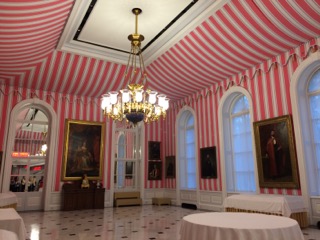
The Tent Room

We were afterwards, given a tour of the public rooms of Rideau Hall along with the Monck wing that is not always open to the public. We were also able to visit the Green Houses that are attached to Rideau Hall.  Our tour guide Sophie gave a us excellent history of Rideau Hall as we toured and were able to admire the impressive quantity and quality of Canadian Art that is displayed in the rooms.
Sophie our very informative guide and our Bookclub member Shirley


A bird's eye view of the Green Houses


The Green houses were filled with wonderful plants and flowers, many of them in pots to allow them to be used as decor when special events are held or special guest come to visit.  Their Excellencies Mr. and Mrs. Johnston have several grandchildren and we saw peaking under some plants, dinosaurs hidden by the Governor General himself!


It was an extraordinary meeting of the Muse & Views Bookclub and we thank our member Linda and her friend Norma for organising it for us.  We also thank Her Excellency Sharon Johnston for hosting such a memorable meeting for us.  Lastly of course, this being the home of the Vice-Regal couple of Canada, our member Janet gave us a Royal wave at the end of our meeting!

Janet giving us a Royal wave! 


Tuesday, May 31, 2016

Meeting of May 30, ,2016


The book this month was No Relation by Terry Fallis, Linda's choice.  We met at Michèle's new home and she served a fig and walnut dip with vegetables, pear, chèvre and procuitto tarts and a pâté. In honour of Marie Antoinette in the novel, we had a fancy chocolate cake.  Betty, Carla, Colette, Jane, Jolene, Linda and Michèle were present.

The author Terry Fallis is a Canadian from Toronto who was educated as a mechanical engineer but never practiced.  He developed a career as a political strategist working with politicians both at the federal and provincial levels.  He maintained a blog mainly as a political pundit and at one point decided to try his hand writing a novel.  His first novel, The Best Laid Plans, he self-published and it was later picked up and published by McLelland & Stewart. It won the 2008 Stephen Leacock Medal for Humour and won the Canada Reads competition in 2011. He has written to date, 5 novels and is presently working on a 6th novel.

Everyone enjoyed this book, the second novel we have read by Terry Fallis.  It is a funny, insightful novel that tells the story of a man who shares his name with the American author Ernest Hemingway, with a slight difference in spelling Earnest Hemmingway.  He forms a self-help group with other persons who have names of famous persons and together they help each other out with their frustrations that come from sharing a name with a well-known person.  A camaraderie and close friendship develops between the members of the group and their experiences make for funny and often poignant situations.  There is also a second story in this novel about Earnest's family business called Hemmingwear that adds to the complexity of the novel.  All agreed that the book was very enjoyable, easy to read and interesting giving us chuckles and out right belly laughs.

Jolene was intrigued by the cover design that has a bear and a person dressed in a bear costume facing each other.  After some discussion we came to the conclusion that it must represent Ernest Hemingway, the American author who was a bit of a bear in stature and look and who apparently had a real bear as a friend and the principle character of this novel Earnest Hemmingway.

Thank you Linda for a great read!

Monday, June 15, 2015

Meeting of May 25, 2015


Muse & Views was hosted by Michèle. Present were Beth, Betty, Carla, Jane, Janet, Jolene, Linda, Michèle and Shirley.  Michèle served two dips, a guacamole and a salmon mousse with crackers and vegetables, wine, red, rosé and white.  We had a lovely Strawberry Cloud for dessert with coffee and tea.

The book discussed this month was Linda's choice, Tell by Frances Itani. She was born in Belleville Ontario and grew up in Montreal where she trained as a nurse.  She has lived in several countries such as Croatia, Germany and Austria.  She speaks English of course, French, German and some Japanese.  She presently lives in Ottawa.

This book, Tell, follows several of the characters of her former book, Deafening, that we read and discussed in September 2013. In Deafening the main character was a young girl, Grania, who is deaf. She is present only through correspondence in this book.  The main characters are two couples, Maggie and Em who have been married 25 years and Tress and Kenan a young couple. Tress is Grania's sister.  Both couples are grappling with marital problems in silence.  There are secrets untold and secrets to tell in this novel.

Kenan has come back from the ravages of World War I with both physical and psychological scars. He refuses to talk to Tress or others, refuses to go out of their home because of the physical damage to his face and body. Ms. Itani gives us an excellent account of the way Kenan's horrific physical injuries are markers for his wounded heart and soul. Tress turns to her aunt Maggie to try to find solutions to Kenan's uncommunicative behavior.

But Maggie has problems of her own with her husband Em.  There are secrets between them not discussed that are revealed only near the end of the novel. Their relationship has withered over the years. Late in the novel we find out that Maggie and Em had a personal tragedy that they have never discussed.  Maggie finds solace in other activities and in the director of the local choral society.

Most members really enjoyed this novel. They enjoyed her writing style, the attention to period detail, the discussion of a new author L.M. Montgomery for example. She describes well life in a small town, what is important to people, how they cope with winter.  There is a good flow to her writing. Some were a bit frustrated by the slowness of the novel at the beginning and some felt the end was a bit rushed.  However all felt that character development was excellent; we know the characters well by the end of the book.

Linda corresponded with Ms. Itani and learned that there will be a third book set after WW II with the same characters. There were several questions that are not answered in Tell that we hope will be answered in the last novel of  the trilogy.

Monday, October 6, 2014

Meeting of June 23, 2014


We are discussing Linda's choice this month A Man called Intrepid by William Stevenson. Linda is hosting at Shirley's home. Present are Betty, Carla, Colette, Jane, Jolene, Linda, Michèle and Shirley. Pinwheel sandwiches, British cheese and a wonderful chocolate cake with ice cream and strawberries is served with of course wine, coffee and tea.

It is important to distinguish between the author of this book, Bill Stevenson and the Intrepid himself, William Stephenson. William Stephenson was born William Stranger in Winnipeg and took his adopted parents' name Stephenson.  Bill Stevenson was a British born author who met the Intrepid while training as a pilot in Canada.

The book, published in 1976 is a bit of a biography of William Stephenson but much more an account of the creation of the world's first coordinated Secret Intelligence Service by Winston Churchill and how its first chief, William Stephenson, operated.  It documents how the BSC (British Security Coordination) was able to get from Poland the German's Enigma Coding machine and was then able to obtain information about the German tactics and many other operations that eventually helped the Allies win WW II.  It also documents the creation of a training centre in Ontario near Oshawa.

We learn about campaigns such as Dieppe that Allies knew would be a massacre but that it was a means to an end. We learn about how so many people at first did not understand what Hitler was doing.

Everyone enjoyed the book especially since we learned a lot about World War II secret campaigns and the connections between Britain and Canada during the War and also the connections between British and Canadian Secret Intelligence Services after the war.

Thursday, June 6, 2013

Meeting of May 27, 2013


We met at Michèle's home.  In keeping with the fancy atmosphere of Academy Awards night in the book, we were served a pâté and cheese ball covered in caviar and a nice avocado herb dip with vegetables.  A refreshing fruit salad with lime, lemon and orange sugar cookies was our dessert.  Of course wine was served as usual.  We discussed No Time to Wave Goodbye by Jacquelyn Mitchard presented by Linda.

This story continues the saga of the Cappadora family that begins in Ms. Mitchard's novel The Deep End of the Ocean.  Linda mentions that she had not realized when she picked up this book and chose it for us that it was a follow-up.  Some of our members had read The Deep End of the Ocean but many had not.  Ms. Mitchard has written several novels both for adults and young adults.  Linda, Shirley and Michèle had the opportunity to speak with her via Skype and had an interesting and very pleasant conversation about the extensive preparation and research she does before writing a novel. We also talked about how she arrives at the ideas and plots for her books.  She indicated that she draws many of her ideas from real-life stories related in the media or articles she reads.

The Deep End of the Ocean, the first book about the Cappadora family was critically acclaimed and became the first book of Oprah Winfrey's Book Club.  No Time to Wave Goodbye, the follow-up and the story we read this month received more mixed reviews.  As most of us had not read the first book, we found that we were not able to relate as well to the characters and found some of the issues in the book confusing.

Many found the beginning of the book slow but eventually found that it was a page turner, suspenseful and the happy ending pleased all of us.  Linda, who has now read several of Ms. Mitchard's books recommended we read The Deep End of the Ocean. 

Sunday, June 3, 2012

Meeting of May 28, 2012


This meeting was hosted by Colette.  Present were Beth, Colette, Jane, Jolene, Linda, Michèle and Shirley. This month's book was The Best Laid Plans by Terry Fallis presented by Linda.  The book was recommended to Linda by a teacher and librarian.  She read both this book and Mr. Fallis' second book The High Road that is a sequel. After she read the books, she decided that a book that gave us the chance to laugh was a good choice.  Mr. Fallis won the 2008 Stephen Leacock Medal for Humour and The Best Laid Plans won the 2011 Canada Reads competition.

All of us agreed that it was a very pleasant and interesting book.  Even Michèle who prefers dark, dramatic books enjoyed the story.  The story is about a political speech writer for the Liberal Party who wants out of the political life as an election is about to be called.  To appease his feelings of guilt of leaving the Liberal leader high and dry, he agrees to find a liberal candidate for an Ottawa area riding that has not voted liberal for decades.  He ends up managing the campaign with little money and no input from the candidate.

We all related to the local settings, the Cumberland-Prescott riding, Parliament Hill, downtown Ottawa, downtown Cumberland, the University of Ottawa.  All of us could "see" in our minds places that he described in the book.  The characters were well developed and easily imagined.  Angus was definitely the favourite character from the book.  The diary that Angus wrote to his departed wife, Marin Lee, a well-known feminist was moving and allowed us to see a side of Angus that was not evident in his everyday discussions with Daniel; Angus' way of pushing through the grief.  It was a favourite part of the book for many of us.  The twists and turns of the campaign had all of us turning the pages and wondering what would happen because of course, we all knew there had to be some way Duncan Angus McLintock would win because that is where the story was going!


Linda wrote to Terry Fallis and arranged for us to Skype with him during our meeting.  We all found it very easy to speak to him and several of us asked questions and related some of our observations. We asked if political pundits noted that he had an incident of "robocalls", directing voters to fictitious polls in his book way before the scandal of the Canadian 2011 federal campaign. Did someone copy the idea from his story?  It was very generous of him to give us of his time on a Monday evening.  Mr. Fallis' next book is Up and Down,  to be published in September 2012 is about astronauts, a departure from his politically based novels.

We offered to give him a tour of the riding of Cumberland-Prescott the next time he comes to Ottawa.  Though Mr. Fallis described the riding fairly well, he admitted to us that he has never actually been to Cumberland!

Thank you Linda for an excellent choice, great book to read; laughter is good for the soul!

Saturday, November 27, 2010

Meeting of November 22, 2010

The Muse and Views Bookclub met at Beth's home to discuss Linda's choice Sarah's Key by Tatiana De Rosnay. Present were Beth, Betty, Carla, Colette, Janet, Jolene, Linda, Michèle and Shirley.  Beth had some delicious cheeses and in honour of France,  "deux petits gateaux".  Thank you Beth.

The novel tells the story of a young girl, Sarah and her family who are caught in the roundup of Jews in Paris in July 1942 into a Vélodrome and then to camps outside of Paris.  The second story of the novel is about an American journalist, Julia who researches the roundup of Jews and discovers a connection to her husband's family.

There was consensus about the worth of this novel, all enjoyed the book and this has not been the case in the books read this year.  Several of us found it very compelling and read it in one sitting. We all felt that despite the tragedy that is exposed in this story, the book is well written and was easy to read.  The flow between the past and the present is well done and many felt that the author timed the change from the Sarah's story during World War II and Julia's story in the present to be excellent.

Another consensus was that a novel that reveals a historical event that none of us had read or heard of previously adds to our knowledge and many enjoyed the book because of this. A Case Study about the Vélodrome d'hiver Round-up on "The Online Encyclopedia of Mass Violence" reveals the horror of this event and shows that Ms. De Rosnay's account is quite accurate.  Many were surprised by the active participation of the French government and police in the horrendous activities of the Nazis.

We all felt that the characters were well developed, we could visualize them, even those that did not come up often in the story such as Julia's sisters-in-law.  Michèle even described an image of Bertrand, Julia's french husband, head held high, white scarf draped around his shoulders, hair a bit long with a lock of hair on his forehead, charismatic but also haughty.

The only negative comments about the novel is that many of us felt that some incidences were too contrived, coincidences too frequent and unnatural.  For example, her abortion was schedule on the anniversary of the Vel'hiv roundup, July 16th. Some of us felt that the ending when she meets with Sarah's son, George in New York and the obvious attraction was too much of a coincidence that they would both find themselves in New York, both divorced.

This was one of several novels we have read in the past two years that take place during World War II, Suite française,  Those Who Save Us, The Guernsey Literary and Potato Peel Pie Society and La's Orchestra Saves the World.  

Tuesday, October 27, 2009

Meeting of October 26, 2009


This month's meeting was at Beth's home. In attendance were Beth, Betty, Carla, Colette, Jane, Janet, Linda, Michèle and Shirley. This month's book suggested by Linda was The Hatbox Letters by Beth Powning. Ms. Powning lives in New Brunswick. She has written several books and this is her first novel.

The novel is about a woman who has recently lost her husband and is having great difficulty getting through the grief and moving on with her life. Most members enjoyed the book with some reservation. Many felt that a better editor would have helped the book flow better especially the first part that was filled with adjectives and descriptions that were too detailed. One member read the following passage that she had read to her husband:
"She felt young because she wore no underpants, and she'd shrugged back her bathrobe to show Tom how her breasts were like silver spoon backs."
The member told us that she then went to her cutlery drawer and took out teaspoons, dessert spoons, soup spoons and service spoons and proceeded to ask her husband which ones best represented her breasts! We had a good laugh.

Despite the shortcomings of the book, all felt that Ms. Powning represented a subject, grief, that solicited a lot of thoughtful discussion. Many of us talked about grief and how people we knew pulled through it and continued their lives or never really were able to build a life on their own after the death of a spouse. In finally going through the letters from her ancestors that were in the hatboxes, permitted Kate to imagine their lives and the losses they endured. She often imagined scenes from one or two sentences in a letter. Losing herself in the lives of her ancestors helped her in some ways to pull through the grief and eventually begin a life on her own.

Many members felt she had a good sense of place. Her descriptions of rural New Brunswick, of her home and garden, the river and the sea made it easy to visualize her surroundings. Those of us who are gardeners enjoyed her descriptions of the garden she and her husband Tom had created over the years.

We discussed the reasons why some people seem to survive grief and manage to build a productive and fulfilling life afterwards and that others have much more difficulty getting past the loss of a spouse. Some felt that women who have had an independent life before or during their relationship probably found it easier to build a life on their own after the loss of a spouse while others felt that it depended on making a decision to give of themselves through, for example, volunteer work.

One of our members who had read the book several years ago went back to her notes and had then thought that maybe the writing style, the jumbled thoughts and short sentences of the beginning of the book and then the more thoughtful descriptions and more flowing sentences may have been used to portray how grief affected Kate. At the beginning she was overwhelmed by the loss and unable to think straight and as time passed and she began to accept more her life, the book's writing style changed, became more fluid, easier to read.

Finally all members said that they enjoyed the book with some reservation.


Sunday, November 2, 2008

Meeting of October 27, 2008


We met at Joan's home and discussed the film, "Last King of Scotland" based on the book of the same title by author Giles Foden. Thank you to Joan for hosting this evening's meeting. The cheese plate was especially appreciated. We had almost full attendance, Beth, Betty, Carla, Colette, Linda, Janet, Joan, Jolene, Shirley and myself Michèle.

The movie is a fictionalized version of Idi Amin's rule as dictator in Uganda. General Amin is played by Forest Whitaker. It is based around the story of a young scottish doctor, Nicholas Garrigan, played by James McAvoy who becomes Idi Amin's personal physician.

Most members thought the film was well done though many visual errors were apparent in the movie. All members felt that Forest Whitaker was excellent and portrayed Amin's paranoia very well. Some members saw a correlation to the rise of Hitler, the charisma that mesmerized the population. Some members saw a correlation to MacBeth, King of Scotland and very paranoid. Members also felt that James McAvoy played Dr. Garrigan well as a naive easily influenced young man.

This month's choice generated a particularly good discussion. It is very apparent that this is a serious book club! Many members had very thoughtful and insightful comments. Two members had read the book even though the only requirement was viewing the movie. The plot and characters were quite different from the movie itself. One member did research on the British Empire and the impact of the British rule and quick withdrawal from African colonies. One member watched the director's version that gave background information on what scenes are fictional and what scenes are based on facts. There was a good discussion about the so-called benevolent but domineering and racist British rule that did not properly prepare native leaders for independence.

All members felt that this was a good choice generating a lot of discussion and thoughtful insight. Thank you Linda and thank you also to MJ.


Thursday, February 28, 2008

Meeting of February 25, 2008

The meeting was held at Michèle home. In attendance were Colette, Janet, Joan, Jolene, Linda and Shirley along with Michèle. The book this month was Unbowed, the autobiography of Wangari Maathai presented by Linda. She is the first African woman and environmentalist to win the Nobel Peace Prize that was awarded to her in 2004.
The book was enjoyed by all members present at the meeting. It has been many months since all liked the suggested book! All felt that Ms. Maathai's life has been inspirational. Many members noted her positive attitude and determination not to back down when she believed in her goal. She founded in 1977, the Green Belt Movement. In the first 10 years, the GBM planted over 20 million trees in Kenya alone. She has worked with mothers and strongly believed that every tree planted is significant and that each alone may be insignificant but the cumulative effect has a significant impact. She has given many women a goal and has empowered them to change their community.
Ms. Maathai's description of her childhood and of Kenya give's the reader the opportunity to learn about what Africa was like, what it is today, what is needed to become a developed continent. We also talked about what she had to sacrifice for the greater good, her family life and her health. She acknowledges throughout the book that the opportunity to study in the United States via the "Kennedy Airlift" gave her the confidence and knowledge she needed to stand up for what she believed further in her life.
Those who wish to read more about the Green Belt Movement can check the website. It has along with information about the Movement, ongoing articles about the present situation in Kenya.
As usual Jolene found the reference to the title of the book. In the Anchor Books 2006-07 soft-cover edition, it is on page 222. halfway through chapter 10. The actual quote is "The story of Freedom Corner did not end with my hospitalization or the dispersal of the mothers. We remained unbowed. The day after the police attach, many of the women, on their own, returned to Freedom Corner". The Webster dictionary defines the word "Unbowed" as 1. not bowed down; 2. not subdued. it is, in my opinion (Michèle) the perfect title for the autobiography of this woman!
The next meeting is March 31st, one week later than the normal 4th Monday of the month because of Easter. It will be at Beth's home. The book is Jolene's choice Life of Pi by Yann Martel.
April's meeting will be at Linda's home with Beth's choice of book, The City of Falling Angels by John Berendt. Those of you who enjoyed his first book Midnight in the Garden of Good and Evil will surely enjoy this book about Venice!
May's meeting will be at Shirley's home with Colette's choice, Suite Française by Irène Nemirovsky.

Sunday, January 20, 2008

Books read in 2007 - Choose your favorite!

BOOK CLUB - 2007
 
January – City of Joy by Dominique Lapierre
The story concerns a polish priest living in West Bengal, India, Stephan Kovalski, who is trying to help and understand life in a Howrah slum (across the Hooghly river from Kolkata) called Anandnagar (City of Joy). Among its various protagonists is the rickshaw puller, Hasari Pal who becomes a central figure in the novel. Despite the abject poverty and injustice, the inhabitants of Anandnagar display an inscrutable acceptance and celebration of life - an attitude that humbles fate and dignifies life.
February - Home to Harmony by Philip Gulley
Come home to Harmony, Indiana, a peaceful slice of small-town America, as Sam Gardner, Harmony-born and raised, begins his inaugural year as pastor to a new flock of old friends, family members, and outrageous eccentrics -- in this unforgettable place where earth-shattering events rarely occur, but small life-altering ones happen daily.
March - The Lovely Bones by Alice Sebold
The book is the story of a 14-year-old girl who is raped and murdered. She tells her story from her personalized Heaven looking down as her family tries to cope with her death and her killer escapes the police.
April – State of Fear by Michael Crichton
State of Fear is a 2004 novel by Michael Crichton published by HarperCollins on December 7, 2004. Like most of his novels it is a techno-thriller, this time concerning eco-terrorists who attempt mass murder to support their views. The book contains many graphs and footnotes as well as two appendices and a twenty page bibliography.
Crichton, who spent 3 years studying the theme, included a statement of his own views on global climate change at the end of the book, saying that the cause, extent, and threat of climate change is largely unknown and unknowable. This has resulted in criticism by scientists as being inaccurate and misleading. He warns both sides of the global warming debate against the politicization of science. He provides an example of the disastrous combination of pseudo-science and good intentions, in the early 20th-century idea of eugenics. He finishes by endorsing the management of wilderness and the continuation of research into all aspects of the Earth's environment.
May - The Wide Sargasso Sea by Jean Rhys

Wide Sargasso Sea is a 1966 postcolonial parallel novel by Caribbean-born author Jean Rhys. After many years of living in obscurity since her last work, Good Morning, Midnight, was published in 1939, Wide Sargasso Sea put Rhys into the limelight once more and became her most successful novel.
The novel acts as a prequel to Charlotte Brontë's famous 1847 novel Jane Eyre. It is the story of the first Mrs Rochester, Antoinette (Bertha) Mason, a white Creole heiress, from the time of her youth in the Caribbean to her unhappy marriage and relocation to England. Caught in an oppressive patriarchal society in which she belongs neither to the white Europeans nor the black Jamaicans, Rhys' novel re-imagines Brontë's devilish madwoman in the attic. As with many postcolonial works, the novel deals largely with the themes of racial inequality and the harshness of displacement and assimilation.
June - Bloodletting & Miraculous Cures by Vincent  Lam
Bloodletting & Miraculous Cures welcomes readers into a world where the most mundane events can quickly become life or death. By following four young medical students and physicians – Ming, Fitz, Sri and Chen – this debut collection from 2006 Scotiabank Giller Prize winner Vincent Lam is a riveting, eye-opening account of what it means to be a doctor. Deftly navigating his way through 12 interwoven short stories, the author explores the characters’ relationships with each other, their patients, and their careers. Lam draws on his own experience as an emergency room physician and shares an insider’s perspective on the fears, frustrations, and responsibilities linked with one of society’s most highly regarded occupations.
September – The Memory Keepers daughter by Kim Edwards
Award-winning writer Kim Edwards's The Memory Keeper's Daughter is a brilliantly crafted family drama that explores every mother's silent fear: what would happen if you lost your child and she grew up without you?
On a winter night in 1964, Dr. David Henry is forced by a blizzard to deliver his own twins. His son, born first, is perfectly healthy. Yet when his daughter is born, he sees immediately that she has Down's syndrome. Rationalizing it as a need to protect Norah, his wife, he makes a split second decision that will alter all of their lives forever. He asks his nurse to take the baby away to an institution and never to reveal the secret. But Caroline, the nurse, cannot leave the infant. Instead, she disappears into another city to raise the child herself. So begins this beautifully told story that unfolds over a quarter of a century in which these two families, ignorant of each other, are yet bound by David Henry's fateful decision that long-ago winter night.
October - Perfume--the Story of a Murderer by Patrick Suskind,
An international bestseller, set in 18th century France, Perfume relates the story of Jean-Baptiste Grenouille, "one of the most gifted and abominable personages in an era that knew no lack of gifted and abominable personages".
Born lacking a personal odour (a fact other people find disquieting) but endowed with an incomparable sense of smell, he apprentices himself to a perfumer and becomes obsessed with procuring the perfect scent that will make him fully human. In the process, he creates perfumes—presumably based on pheromones—that powerfully manipulate human emotions, murdering 25 girls to take their scent.
The book features detailed descriptions of the techniques of scent extraction such as maceration and enfleurage.
November - Charles the Bold: the Dog Years by Yves Beauchemin,
Charles the Bold: The Dog Years is the first in a series of four novels that chronicle the life of Charles Thibodeau, a youngster from Montreal’s notorious east end. In this first volume, Yves Beauchemin takes us from Charles’ premature birth in October 1966 to his first term in secondary school. In the first pages the reader realizes that Charles is a special child and that his life is going to be far from ordinary. Although he is “born with a natural gift for happiness,” Charles’ childhood is overshadowed by tragic events. His mother never fully recovers from the birth of his younger sister Madeleine and both sister and mother die before Charles reaches the age of four. Left with his alcoholic father, Charles suffers from the domestic violence Wilfrid Thibodeau repeatedly inflicts upon him. One night the carpenter even attempts to murder his son, who then seeks refuge with the Fafard family.
References:
Amazon.ca

Mdextras
2007-12-29