Tuesday, February 27, 2018

Meeting of February 26, 2018


We met this evening at Janet's home to discuss Carla's choice, The Nightingale by Kristin Hannah.  Present were Beth, Betty, Carla, Colette, Jane, Janet, Shirley and Michèle via Skype from sunny Florida.  As the book is set in France, Janet had some wonderful French cheese, pâté, French wine and for dessert, tarte aux pommes with crème chantilly.

Everyone enjoyed The Nightingale. This is the second book we have read by Kristin Hannah, so those who would like some information on this author can click on the link.  This story is about two sisters in France during World War II and how each coped with the tragedy and events of war.  Vianne, married and living with her daughter in a small village while her husband is fighting endures the humiliation of Nazis living in her home and overtaking the village. Isabelle, the younger single sister who lives in Paris with her father, eventually finds her calling helping those of the resistance escape from France once they are denounced.

The character development of the two sisters is excellent.  We really get know each sister and understand in each of their circumstances how and why they react to events in their life.  Vianne, a mother, will do anything to protect her own child and finds a way to protect and keep her best friend Rachel's, son.  Though her sister Isabelle does not understand how Vianne can allow a Nazi to live under her roof, Vianne knows the consequences of refusing and finds ways to live with it and protect her daughter. She accepts the food and gifts from the first officer so her daughter can eat properly and she endures repetitive rape by the second officer to protect her daughter from the same fate.  Isabelle, younger more of a rebel and without the responsibilities of a family, finds a way to help her countrymen in the Résistence.

Many of us enjoy historical novels that allow us to learn and this novel packs it in. We learn about how the Nazis with the help of some French collaborators rounded up Jews not only in big cities such as Paris and Lyon but also in small villages.  Though we did learn about the the French fleeing Paris in Suite Française by Irène Nemirovsky, there are different aspects and details in this book. In All the Light We Cannot See by Anthony Doerr we learned about the Résistence and in The Nightingale, Isabelle's involvement gives us more information.   Kristin Hannah's research for this book was extensive.

Thank you Carla for choosing this book and Shirley for recommending it.


Tuesday, January 30, 2018

Meeting of January 29th, 2018


As we begin the 20th year of our Muse and Views Book Club, we met at Colette’s to discuss Still Life by Louise Penny. Attending were Jane, Janet, Shirley, Colette and our newest member, Sharon (Welcome to Muse and Views, Sharon!), plus Michèle and Linda who Skyped in to join the discussion. In keeping with the theme of the book, Colette served an array of Québec cheeses, stuffed mushrooms, and croissants followed by home-made mini lemon tarts, fit for any boulangerie.
The author, Louise Penny, came to writing later in life, having previously been a journalist with the Canadian Broadcasting Corporation. Her husband, Michael, who she describes as ‘kindly, thoughtful, generous, a man of courage and integrity, who both loved and accepted love’, was her inspiration for Armand Gamache. She lives outside a small village south of Montréal, quite close to the American border, and has used the Eastern Townships for the setting of her imagined village of Three Pines and the Inspector Gamache series.
Still Life is Louise Penny’s debut novel and has garnered a number of awards; her subsequent books continue to win accolades. In 2013, she was made a Member of the Order of Canada "for her contributions to Canadian culture as an author shining a spotlight on the Eastern Townships of Quebec”. She has been compared to Agatha Christie in her writing style which features many hallmarks of the British whodunit genre, including murders by unconventional means, bucolic villages, large casts of suspects, red herrings, and a dramatic disclosure of the murderer in the last few pages of the book.
Although all felt that the book was an ‘easy read’, our reviews were mixed. The devices and red herrings used in the book seemed too obvious. Some felt that character development was weak however one of the members, who had read the entire series, explained that the characters do fully develop over the series.
The description of the very rural village of Three Pines was well done as was most instances of family dynamics. Meanwhile, the conversation Inspector Gamache had with Ben about the dwindling rights of Anglophones in Québec was off-putting and definitely one-sided. The portrayal of Gabri and Olivier, the gay owners of the bistro and bed and breakfast, was felt to be rudely stereotypical.
This month’s book discussion was as lively as usual and reading a Canadian author is never a bad thing.

Saturday, December 2, 2017

Meeting of November 27th 2017


We met a Beth's home to discuss Shirley's book choice Home Front by Kristin Hannah.  Present were Beth, Carla, Colette, Linda, Michèle and Shirley.  Beth offered us a very nice array of hot and cold canapés along with a variety of nuts and sweets.  Of course we had the usual wine, red and white and tea and coffee.

Kristin Hannah is an American author and former lawyer.  She has written 20 novels, Home Front and The Nightingale are the most popular.  She has received several awards, especially for The Nightingale.

Home Front is a timely and intimate look at the effect of a deployment on a family.  Jolene, a helicopter pilot in the Reserves is deployed to Iraq and Michael, her husband, who is a lawyer, finds himself with the responsiblity of taking care of his daughters and keeping the home going.  As Jolene is about to leave, Michael expresses his doubts about their relationship.

Jolene finds her deployment and work in Iraq much more challenging than she had anticipated and the uncertainty of Michael's love and commitment to their relationship weighs on her emotions.  Michael begins to realize the sacrifices Jolene has made, the work she has put into their relationship and the lack of responsibility on his part in their relationship.

We all found the book to be a pager turner and easy read as the writing style is very straight forward.  The characters were well described and we found our feelings towards them changed as the situation changed.  Life on an Iraq base was well described, the heat, the dust and sand, having to line up to call home, the line ups for showers all made the difficult life soldiers had real.

The author described well the anger the characters felt,  Jolene’s inablity to speak out and Michael's concentration in his work to the detriment of his family, his inability to understand what Jolene was doing and the importance of her work for her as a person and a soldier.  She did a good job of describing the transition Michael went through as he found himself responsible for his children and the effect it has on his feelings towards Jolene.  

One of our members remembered that Tolstoy's Anna Karina begins "Happy families are all alike; every unhappy family is unhappy it its own way." It is a good description of this family and its struggles.  

Thank you Shirley for an interesting read.  


Tuesday, October 24, 2017

Meeting of October 23rd, 2017


We met at Shirley's home to discuss Jane's book choice The Chilbury Ladies' Choir by Jennifer Ryan. Present were Beth, Colette, Jane, Janet, Linda, Michèle and Shirley.  As usual, Shirley had a wonderful array of food for us, crab rolled sandwiches, stuffed cherry tomatoes, pigs in a blanket and wonderful bacon and fruit tarts.  She had a wonderful clementine cake, a Nigella Lawson recipe.  Click on the link to get the recipe.

This is Jennifer Ryan's first novel.  She was born in England and now lives in Washington DC with her husband and children. She was a book editor specializing in non-fiction books such as economics, politics, health and biographies.  The Chilbury Ladies' Choir was inspired by stories her grandmother told her, who was 20 when WWII broke out and who lived in a small British village.

The story is told in the novel through letters written by some of the characters and journal entries by other characters.  It is similar to an epistolary novel Pamela; or Virtue Rewarded by Samuel Richardson told through a series of familiar letters. It could also be compared to Henrietta's War: News from the Home Front 1939-1942 written by Joyce Denny's and part of the Bloomsbury Group.

As we read the journal entries and letters we not only learn about what is happening in the village of Chilbury during 1940 from March to September but we become acquainted with the main characters, Mrs. Tilling, Kitty, Venetia and Edwina Paltry. In reading the letters and journal entries we become familiar with other characters in the novel such as Prim the choir master, the Brigadier, Kitty and Venetia's father, Colonel Mallard, Henry and his fascination with Venetia and Kitty's puppy love for him, and Mr. Slater who Venetia targets on a dare by her friend Angela.

Most of us enjoyed the novel and found it a nice light easy read with interesting characters and a good story line.  The map of the village and the descriptions of the different buildings and areas of the village allowed us as readers to imagine the characters in their environment.  The Ladies Choir is a good unifying tool, allowing us to observe the interaction between the characters and also showing how, when war left a village with only the women and older men, the strengths and backbones of the village came from the women.

Several members commented on how  characters such as Venetia, Mrs. Tillings and Henry evolve as events happen and the story line changes.  At the beginning though Hitler is taking over many areas of Europe, England is unaffected, it is almost like a phony war.  As events occur and Hitler begins to bombard southern England, Dover is constantly hit and Chilbury is bombarded, the deaths of husbands and boys and those of loved members of the village, Prim and Harriet changes the narrative in the journals and letters. Venetia matures, not only because of these events but also because of her growing love for Alastair Slater. Mrs. Tillings becomes less timid and develops as a strong supportive person.

Some felt that there were some areas where we were left hanging a bit.  What happens to Mrs. Tilling's son David?  Does Edwina really get away without consequences? Some also felt that Kitty's journal entries were not the narrative of a 13 year old.

Though we found the book to be an easy light read, it had excellent character development, good references to how WWII affected England and villages.  It had two good love stories and though many events were quite predictable such as the baby swap and Mrs. Tilling and Colonel Mallard's developing relationship, it was enjoyable to read.

Thank you Jane for a good choice.

Books and Meetings 2018

The list will be updated as members choose their books.

Monday January 22nd -  Janet's book choice, Still Life, by Louise Penny, Colette hosting

Monday February 26th - Carla's book choice, The Nightingale  by Kristin Hannah, Janet hosting

Monday March 26th - Betty's book choice, The Piano Maker by Kurt Palka, Carla hosting

Monday April 23rd - Michèle's book choice, Kamouraska by Anne Hébert, Jane hosting

Monday May 28th - Linda's book choice, Flee, Fly, Flown by Janet Hepburn, Shirley hosting

Monday June 25th - Beth's book choice, Brooklyn by Colm Tóibín, Linda hosting

Monday September 24th - Colette's book choice, They Left Us Everything by Plum Johnson, Michèle hosting

Monday October 22nd -  Jane's book choice, The Music Shop by Rachel Joyce, Betty hosting

Monday November 26th - Shirley's book choice,  A Gentleman in Moscow by Amor Towles, Beth hosting

Monday, October 9, 2017

Meeting of September 25th, 2017


This is our first meeting since one of our founding members, Jolene, passed away.  We drank a glass of wine in her memory.  Members with us today are Beth, Betty, Carla, Colette, Jane, Michèle and Shirley.  Michèle served several cheeses and pâtés with grapes and figs, and with wine of course.  Naimimo bars, butter tarts and flourless chocolate cookies were served with tea and coffee. 

This month we are discussing Annie Proulx’s book, The Shipping News, Colette’s choice.  Annie Proulx, born Edna Ann Proulx in 1935 is an American author who began her writing career as a journalist.  She has written several novels and short stories.  Her latest novel is Barkskins.  One of her short stories, Brokeback Mountain, was turned into a very well-reviewed and received movie.  The Shipping News won several literary awards including the 1994 Pulitzer Prize for fiction.  It was also made into a movie with Kevin Spacey, Judi Dench and Julianne Moore.  Ms. Proulx wrote The Shipping News while staying in a cottage near l’Anse aux Meadows in northwest Newfoundland.

The Shipping News is a story about a New York reporter, Quoyle, who decides to move to Newfoundland with his aunt after difficult family life overwhelms him.  The aunt has an ancestral home in Newfoundland and together with  Quoyle’s daughters they move and slowly renovate the home.  Quoyle eventually finds work as a reporter writing about the shipping news on the island.  As in many of her books, there is little joy in this story; characters who are mean spirited, sexual abuse is rampant and very little kindness is apparent. Certainly Quoyle is very protective of his daughters and eventually Quoyle and Wavey get together but it is left to the last 15 pages.  One of our members who has read several of her short stories that are dark and depressing, described this book as her « happy » book.  One member who recently read her newest novel, Barkskins agrees that The Shipping News is not as dark.

Newfoundland’s depressed economy as the cod supply diminishes and Quoyle and his aunt’s stories are influenced by the impact the economy has on the people of Newfoundland.  She describes well life as it is on the island; it almost felt like flipping through an album or a scrapbook, seeing bits and pieces of lives and events that eventually fit together.

Her writing style, did irritate some of us: very short sentences with no verbs, sentences with no subject.  However her descriptions of the landscape and the sea, the rugged beauty were very well done.  Her descriptions of the sea and the weather were full, beautiful and scary in some parts.

She captured well all the characters, the meaness in some of them literally jumped off the page.  Quoyle was a very sympathetic person despite being downtrodden.  He is an ordinary, not particularly attractive person, who copes and perseveres. He is a patient man and as the story develops Quoyle moves closer to a life that offers him satisfaction and love. 

There was a sense in the story from the characters  and descriptions of the pull where we come from has on us as we grow older, how a very strong sense of place stays with us even if we move away. 

It was a worthwhile read, thank you Colette for an excellent choice that generated good discussion. 

Tuesday, June 27, 2017

Meeting of June 26, 2017


We met at Colette's and, although she was unable to attend, Jolene hosted.  Present were Beth, Carla, Colette, Jane, Linda, Michèle and Shirley. We began with a very nice wonton soup and lovely tea sandwiches, a very tasty dip and some nice cheese.  Jolene also made a wonderful frozen rasberry pie with a chocolate crust.  We also had a nice bubbly which some of us drank as a mimosa with orange juice.  Thank you Jolene.  The dessert was especially nice.

This month's book was Do Not Say We Have Nothing by Madeleine Thien presented by Beth.  Ms. Thien was born in 1974 in Vancouver the year her parents immigrated to Canada. Her father was a Malaysian Chinese and her mother was from Hong Kong.  She studied Dance at Simon Fraser University and then completed an MFA in creative writing at UBC.  Do Not Say We Have Nothing is her fifth published book and second novel.  She also published two books of short stories and a children's book, The Chinese Violin.

Ms. Thien's last  two books, Do Not Say We Have Nothing and Dogs at the Perimeter, have dealt with repressive and cruel regimes in China and in Cambodia.  It has meant that she spent the last 10 years researching the devastation and cruelty caused by regimes that controlled the people of their country by fear, repression, starvation and cruelty.

Do Not Say We Have Nothing is the story of three musicians in China, Sparrow a composer, Jiang Kai a pianist and Zhuli a young violinist. The story spans about 60 years beginning when Mao Zhedong came to power in 1949 through to the events of Tiananmen Square in 1989.  The story is narrated by Jiang Kai's daughter Marie who lives in Vancouver.  The story begins in Vancouver with Marie recounting her father, Kai's suicide in Hong Kong in 1989 not long after the events of Tiananmen Square.  The story recounts the trials and tribulations of the three musicians and their families through China's rollercoaster history, from the schemes of the "Great Leap Forward" era of the 1950's,  the famine especially in the countryside when Kai loses his whole family to starvation; the Cultural Revolution and the re-education camps that Zhuli's parents were forced to endure; the destruction of all Western- inspired culture when the Shanghai Conservatory of Music was closed and instruments were destroyed and the pro-democracy student-led demonstrations that ended with the massacres of Tiananmen Square.

Throughout the story the three musicians study and teach.  Western classical music is frequently referenced, beginning and ending with Glenn Gould's interpretation of Bach's Goldberg Variations.  Many of Ms. Thien's most beautiful passages come out of references to music such as Beethoven's Emperor Concerto when Marie is riding in the car with her father in Vancouver (pg 14) or when Sparrow listens with his father to Bach's Goldberg Variations No. 21.

"The seventh canon of Bach’s Goldberg Variations rolled towards Sparrow like a tide of sadness. Sparrow wanted to step out of the way but he was too slow and the notes collided into him. They ran up and down his spine, and seemed to dismantle him into a thousand pieces of the whole, where each part was more complete and more alive than his entire self had ever been.” Pg 74 
 All of us found the book to be a challenging read.  In the first half of the book, especially when it jumps from Vancouver to China and from one era to another, it is difficult to understand who is who and when events are taking place.  However, all found that the book is a worthwhile read.  One of our members described her phrasing as "delicious" and musical.  The complexity of the story required time, many of us taking three to four weeks to finish the book, and a couple of our members read it more than once.  It was informative as we learn a lot about China's modern history and how the decisions of its leaders impact the population and especially the two families we follow.

Beth suggested, for anyone who would like to learn more about China's modern History, Nien Cheng's book Life and Death in Shanghai published in 1986 and available at the Ottawa Public Library.  Michèle also suggested that we read Bob Douglas' review on the website "Critics At Large" The Power of Music and Remembering  .

Thank you Beth for selecting this challenging book and thank you Jolene for providing such wonderful food, good for the soul and spirit.


Tuesday, May 30, 2017

Meeting of May 29, 2017


This month's meeting has been very special.  Linda's book choice for this month was Matrons and Madams by Her Excellency Sharon Johnston.  Our charming Linda through her connections, got us an invitation to Rideau Hall to meet with Her Excellency in person.  Present were Beth, Betty, Carla, Colette, Jane, Janet, Linda, Shirley and Michèle along with guests we were able to bring with us. We were 23 persons all together, including the original organizer of the Bookclub Marilyn Dow.

Bookclub members and their guests with Her Excellency Sharon Johnston

Muse & Views Bookclub members with Her Excellency Sharon Johnston


Her Excellency Mrs. Johnston was extremely gracious and gave us a lot of information about the research she did to write this historical novel and she read two paragraphs from the book, one about Matron Clara Durling and one about Lily Parsons.  During the discussion we learned that Clara Durling is based on Mrs. Johnston's grandmother who had been the Matron at the Galt Hospital in Lethbridge, Alberta.  Mrs. Johnston did a lot of research in Lethbridge, returning seven times and reading all the minutes of the Board of Governors of the Galt Hospital and newspaper accounts of activities and events that involved the Galt Hospital and the Matron of the hospital.  By reading the minutes she was able to acquire a fair amount of knowledge on the interaction between different board members and Matron Durling.  She was able, for example to better understand the animosity  one particular physician/surgeon had for her grandmother and incorporate this difficult relationship in the novel.

From questions that our members asked we learned that the process of taking this information about her family history and turning it into a historical novel was difficult and sometimes emotionally painful.

We also learned that this is the first of a trilogy of historical novels based on her family history.  The next book will probably be out in the Fall of 2018.  Though Mrs. Johnston was reluctant to go into great detail about the future novels, she did tell us, as we can guess from the end of this novel that the next book will be set in part in residential schools for indigenous children, a difficult and controversial topic in our country.

During the discussion, His Excellency Governor General David Johnston sat down with us for a short while to listen to Mrs. Johnston discuss her novel with us and he also put in his two cents about the research and writing process.

After the discussion, tea, coffee and apple cider along with some wonderful cookies were served and Mrs. Johnston signed her book for members who had a personal copy.  She was very generous with her time and the members and our guests were very appreciative of the time and information she gave us.

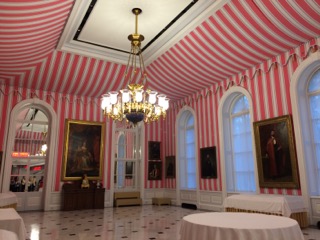
The Tent Room

We were afterwards, given a tour of the public rooms of Rideau Hall along with the Monck wing that is not always open to the public. We were also able to visit the Green Houses that are attached to Rideau Hall.  Our tour guide Sophie gave a us excellent history of Rideau Hall as we toured and were able to admire the impressive quantity and quality of Canadian Art that is displayed in the rooms.
Sophie our very informative guide and our Bookclub member Shirley


A bird's eye view of the Green Houses


The Green houses were filled with wonderful plants and flowers, many of them in pots to allow them to be used as decor when special events are held or special guest come to visit.  Their Excellencies Mr. and Mrs. Johnston have several grandchildren and we saw peaking under some plants, dinosaurs hidden by the Governor General himself!


It was an extraordinary meeting of the Muse & Views Bookclub and we thank our member Linda and her friend Norma for organising it for us.  We also thank Her Excellency Sharon Johnston for hosting such a memorable meeting for us.  Lastly of course, this being the home of the Vice-Regal couple of Canada, our member Janet gave us a Royal wave at the end of our meeting!

Janet giving us a Royal wave!